 Logx
Logx Trading Limits Determine Whether a Perpetual Position Can Open and Remain Viable
A Logx perpetual position can be set up only if a trading product is available and its account connection, collateral, market, margin, capacity and order conditions all permit the request. Some rules define how the venue works, while others are live parameters that can change as exposure or liquidity changes. That distinction matters: a structurally valid order may still fail a current cap, and a price trigger may activate a request without proving final execution. Read the active state first, commit only after those checks agree and confirm the resulting order or position before making another change.
Active product and order paths
Product status comes first because a legacy rule can describe a real mechanism without governing the active venue. Logx's public pages currently conflict: one labels V2 as “Public Access,” while another says Logx will relaunch with a new product. Neither page confirms that V2 perpetual trading is operational now.
Older OG parameters explain that earlier pool design; they do not establish the configuration of a later Logx product. If a trading product is available, its current rules determine which markets, collateral inputs and order controls can be used. A limit copied from the concluded product could misstate current capacity or execution requirements even when the underlying trading concept still applies.
Market-style requests
A market-style request seeks execution under the price protection, margin and capacity rules applied at submission. It seeks immediate execution rather than waiting for a trigger, but it still needs validation. A visible quote does not reserve liquidity or open interest while the reader reviews the order.
Resting price instructions
A resting instruction waits for a specified price condition before execution can proceed. The documented OG design treated a limit order separately from take-profit and stop-loss instructions. In an active product, the displayed order type controls whether the instruction opens, increases, reduces or closes exposure, so its effect must be clear before commitment.
Limits that decide whether size is permitted
Whether a position can open depends on both the account inputs and the market state. Collateral, requested exposure and remaining market capacity must all support the same order.
Collateral and leverage
Collateral backs the position but does not equal its full size when leverage is involved. Increasing size against unchanged collateral raises effective leverage and leaves less room for adverse price movement, fees or other deductions before the maintenance requirement becomes relevant.
The active margin rule matters more than a leverage label by itself. Two requests with the same displayed leverage can have different outcomes when their collateral state, entry price or accumulated charges differ. Any minimum collateral or maintenance value should be read as a live product parameter unless the active rule states otherwise.
Open-interest capacity
Open interest measures outstanding exposure rather than the reader's wallet balance. In the documented OG pool design, each index token had maximum long and short open-interest caps.
A request can fit the account's collateral and still exceed the remaining capacity on its side of the market. The live cap and current usage belong together: a maximum without used capacity does not reveal how much additional exposure the venue can accept.
Price guards
Price guards determine when an order becomes eligible and whether its execution price remains within the submitted condition. An acceptable-price setting constrains an immediate request, while a trigger controls when a resting instruction becomes eligible. Neither setting overrides margin checks, market capacity or the requirement for a valid position when an order attempts to reduce exposure.
Position setup in seven observable stages
Each stage should produce an observable result before the next commitment. This keeps a live-parameter failure separate from an incompatible input.
| Stage | Observable check | Governing condition | Recovery response |
|---|---|---|---|
| Confirm current product availability | The intended product and market are available | Product status and market support | Stop if no current product is available; do not carry over legacy parameters |
| Connect a compatible account | The account connects in the displayed environment | Supported wallet and network state | Correct the connection before moving funds |
| Prepare collateral | Spendable collateral and any required authorization are visible | Accepted collateral and displayed transaction requirements | Keep funds uncommitted until the required state is clear |
| Set direction and size | Direction, size and collateral appear together | Market size rules and margin requirements | Reduce size or leverage without changing unrelated inputs |
| Read live capacity | The requested increase fits available exposure | Long or short open-interest capacity | Wait for capacity or reduce the requested increase |
| Commit order terms | Order type, amount and price condition match the intent | Price protection, trigger logic and execution requirements | Correct uncommitted terms and avoid duplicating a pending request |
| Verify the outcome | The order or position record matches the intended state | Execution status and final transaction state | Resolve a pending or failed state before submitting another order |
This sequence prevents one failure from being mistaken for another. An incompatible input requires a different correction than a capacity failure, while a pending order means that a request already exists.
Commitment and execution as separate states
A submitted request records trading intent, while execution creates or changes the position. The interval between them can matter because price, capacity and account state may change after submission. A wallet signature authorizes a transaction but does not prove that the position was created.
In the documented OG flow, keeper software handled created requests and checked the relevant price condition before execution. An opening request transferred collateral into the vault when successful, while a closing request reduced the position and returned collateral adjusted for profit or loss. Those mechanics describe OG and should not be projected onto V2 where its active state differs.
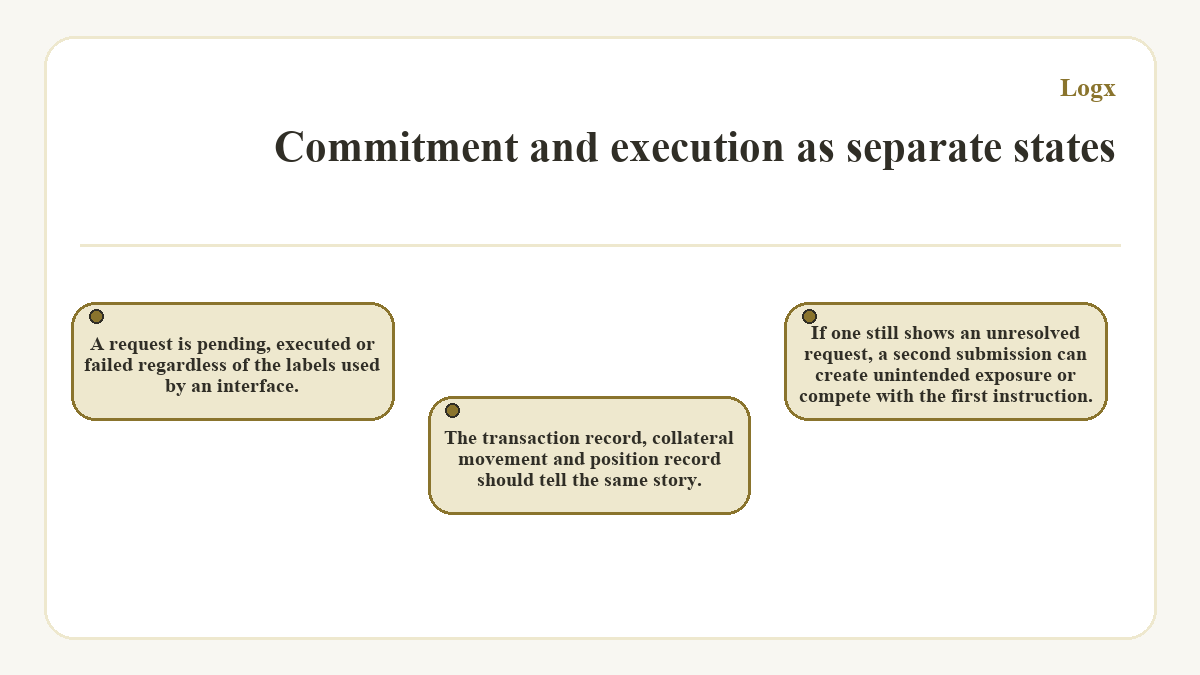
A request is pending, executed or failed regardless of the labels used by an interface. The transaction record, collateral movement and position record should tell the same story. If one still shows an unresolved request, a second submission can create unintended exposure or compete with the first instruction.
Bounded recovery after a failed check
A failed check should change the smallest reversible input. If size breaches live capacity, reduce the requested increase or wait for capacity. If a price guard fails, revisit only that condition. A wallet rejection before submission calls for a connection or authorization correction. Once a request exists, avoid a duplicate until its status and collateral movement resolve. This contains the error without changing the parts of the setup that remain valid.
Background mechanics behind the limits
Open-interest caps bound additional aggregate exposure and are separate from personal leverage. In the documented OG design, separate long and short caps limited directional exposure against the liquidity pool. A changing cap therefore belongs to live market state, while the durable rule is that a new increase must fit the capacity available on its side.
Margin rules continue after entry. Unrealized losses and applicable charges reduce the collateral supporting a position, while favorable movement increases its value before settlement. Liquidation becomes possible when the remaining collateral no longer satisfies the maintenance requirement, so opening successfully does not freeze the position's later risk state.
Price instructions govern eligibility rather than certainty. A trigger can be reached while another validation blocks execution, and an immediate request can fail its price protection before completion. A spot trade mainly exchanges assets and ends with a resulting balance; a perpetual position maintains collateralized exposure that remains subject to margin, market capacity and liquidation rules until it closes.
Things people ask about Logx
Does a connected wallet mean the account can trade immediately?
No, a wallet connection identifies an account and lets the interface request later signatures; it does not authorize those transactions. The selected product must also support the connection, market and collateral state. The user must complete any required authorization before the collateral can be used. The order then faces its own margin, capacity and price checks, so connection status is only the first prerequisite.
Why can a position size that fits the account still be rejected?
Account-level size and market-level capacity are separate checks. The account may hold enough collateral for its requested exposure while the relevant side of the market has too little open-interest capacity remaining. A size rule, margin requirement or live price guard can also block the request. If capacity is the failing check, reducing the increase addresses it without changing an otherwise valid setup.
Should a trader use the OG open-interest caps as V2 capacity?
No. The documentation describes separate long and short caps for each index token in the OG design, not V2. Use a V2 limit only if a current V2 interface displays it for the selected market; otherwise, do not treat an OG value as current capacity.
Do failed requests always return collateral automatically?
The documented OG rule does not establish how every Logx product or failure stage handles collateral. A wallet rejection before submission does not move collateral. The documented OG increase flow terminated requests that failed its acceptable-price condition and returned funds to the sender, but that legacy behavior should not be assumed for V2. Check the final transaction, order record and balance before retrying.
Last updated ·