 Logx
Logx leverage linked collateral to position exposure and liquidation risk
In the documented OG perpetual model, leverage equalled position size divided by remaining collateral. Larger exposure or a smaller collateral balance therefore raised the ratio. Profit and loss, position fees, borrowing costs and funding adjustments could change remaining collateral after entry. The legacy request flow also required an execution payment in the chain's native token. Collateral approval alone was not enough. As that balance moved toward the required maintenance margin, the position had less room before liquidation. The product boundary matters because Logx now labels OG as concluded, while one public page presents V2 as accessible and another announces a future relaunch. Treat the mechanics below as historical, then read any live product's displayed leverage, margin requirement and position state before committing collateral.
Position size and collateral formed the leverage ratio
The calculation used two separate account values. Position size measured the exposure whose profit or loss moved with the market. Remaining collateral was the balance supporting that exposure after relevant adjustments. Leverage is position size divided by the collateral remaining in the position.
The same ratio could therefore rise in two ways: exposure could increase while collateral stayed fixed, or collateral could fall while exposure stayed fixed. Adding collateral without increasing size lowered the ratio. Decreasing size while retaining the same collateral did the same. The arithmetic did not prove that an adjustment was available, because product status, market capacity, accepted collateral and live risk parameters still governed each request.
Maintenance margin defined the liquidation boundary
Maintenance margin set the minimum collateral that the documented position needed to remain open. The documented OG liquidation rule set maintenance margin at 2.5% of position size. That percentage belongs to the legacy model and should not be carried into a different Logx product without a matching live rule.
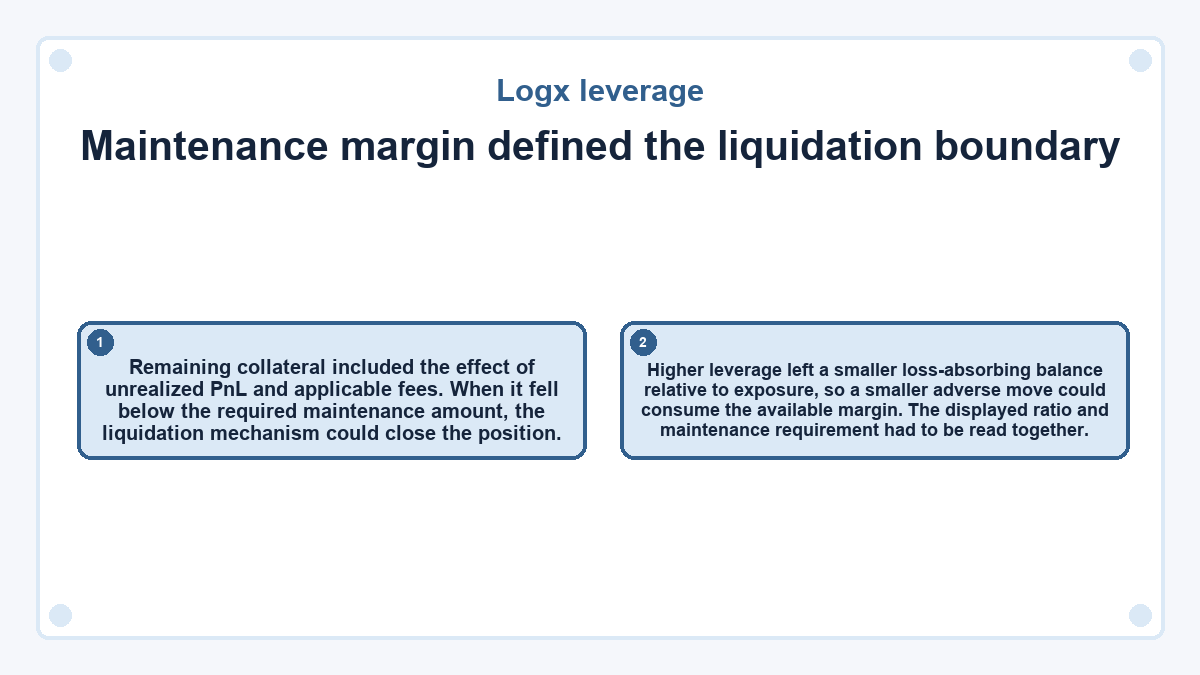
Remaining collateral included the effect of unrealized PnL and applicable fees. When it fell below the required maintenance amount, the liquidation mechanism could close the position. Higher leverage left a smaller loss-absorbing balance relative to exposure, so a smaller adverse move could consume the available margin. The displayed ratio and maintenance requirement had to be read together.
PnL and costs changed effective leverage after entry
Remaining collateral did not stay equal to the original deposit. An unrealized loss reduced it and raised effective leverage when position size was unchanged. An unrealized gain moved the ratio in the other direction, although the gain remained tied to the open position until settlement.
Legacy position fees were deducted from collateral, while borrowing and funding adjustments could also affect the balance. Their leverage effect came through the denominator rather than a separate multiplier. A setting selected at entry could therefore differ from the ratio implied by the later account state.
Market movement was not the only changing input. Increasing or decreasing exposure, withdrawing collateral and accumulated costs could each alter the margin available above liquidation. The current ratio therefore depended on current position size and remaining collateral, not the original leverage selection.
Six account changes produced distinct ratio effects
Ratio changes can be compared without assuming a particular market, asset or live parameter. The table holds PnL and costs constant so that each variable's effect remains visible. It describes the arithmetic rather than promising that every adjustment exists in a current interface.
| Account change | Leverage effect | Account consequence |
|---|---|---|
| Collateral rises while exposure stays fixed | Leverage falls | More collateral supports the same position size |
| Collateral falls while exposure stays fixed | Leverage rises | Less collateral remains above the maintenance boundary |
| Exposure rises while collateral stays fixed | Leverage rises | Each unit of collateral supports a larger position |
| Exposure falls while collateral stays fixed | Leverage falls | The existing collateral supports a smaller position |
| Collateral and exposure rise proportionally | Leverage stays constant | The ratio is preserved before PnL and costs |
| Collateral and exposure fall proportionally | Leverage stays constant | The ratio is preserved before PnL and costs |
| Six comparison patterns | Recalculate from remaining collateral | Live margin rules still determine whether the state is permitted |
Proportional changes preserve leverage only if both values use the same measurement point. A fee deducted during execution or a PnL change between observations breaks that equality. The recorded post-execution state therefore settles the comparison.
Position direction changed PnL rather than the ratio formula
Position direction determined how a price move affected PnL. A long position benefited from a rise in its index price and lost value on a fall. A short position had the opposite exposure. Both directions still compared position size with remaining collateral when expressing leverage.
Acceptable prices and trigger prices served another purpose. They constrained when a request could execute, but they were not inputs to the leverage ratio itself. Once execution changed exposure or collateral, the resulting account values produced the new ratio. Until then, the pending instruction did not establish a new position state.
Request fields separated exposure changes from collateral changes
Request fields made the two sides of the ratio distinct in the legacy contract path. A wallet first submitted an instruction, then a keeper attempted execution. Submission recorded the intended change; only the executed position state showed its effect on leverage.
Increase-side inputs
The increase request carried separate values for collateral and the USD size change. It also identified direction and an acceptable execution price. Keeping these fields separate allowed the contract to test the proposed exposure against collateral, price protection and other active limits.
Exposure delta
The size delta described how much USD exposure the request sought to add. A larger delta raised leverage if the collateral increase did not offset it. Market capacity and position validation could still prevent the increase.
Collateral input
The collateral amount described the tokens offered to support the request. Approval was a prerequisite for transfer, not evidence that the position had changed. Failed execution could leave the requested exposure unapplied and return funds under the documented failure path.
Decrease-side inputs
The decrease request separated the size delta from the collateral delta. Its documentation allowed a zero collateral delta when the request should avoid adjusting leverage through collateral withdrawal. A receiver field identified where withdrawn tokens would go after execution. These inputs needed to match the intended size reduction and destination before the request was submitted.
Liquidation could replace a planned exit
Liquidation acted on the maintenance boundary, not on the trader's preferred exit timing.
A pending take profit, stop loss or limit instruction did not reserve margin. The documented keeper path still required its trigger condition, price validation and a valid open position when execution occurred. If losses and costs reduced collateral below maintenance first, liquidation could close the exposure before the planned instruction completed.
Adding an exit instruction therefore did not remove leverage risk.
The relevant account state was the remaining collateral relative to position size and maintenance margin. Trigger settings described intended execution conditions, while liquidation eligibility followed the risk state. Confusing those two mechanisms could make an apparently protected position look safer than its available margin supported.
Execution records supplied completion evidence
Execution records distinguished a submitted request from a changed position. In the documented model, a successful increase moved collateral into the vault and increased exposure. A successful decrease reduced exposure and transferred the resulting collateral and PnL to the chosen receiver.
Wallet approval showed that a contract could spend an allowed collateral amount. A transaction submission showed that a request had been created. Neither event alone proved that the new leverage ratio applied. The position record, remaining collateral and receiver balance provided evidence of the executed state.
A failed increase request required the same separation. An acceptable-price failure could end the attempted increase without altering the existing position, while the collateral returned to the sender under the documented path. The next decision should follow the unchanged or updated account state, not the requested outcome.
Product status limits present-day assumptions
Product status determines whether these legacy mechanics describe an available action. Logx states that OG has concluded. One public screen presents V2 as publicly accessible, while another says a new product will launch. Those statements do not establish that the OG collateral model, contract functions or margin settings govern any replacement.
Historical documentation remains useful for understanding why exposure, collateral and maintenance margin must be separated. It does not establish a current maximum leverage, supported market or liquidation threshold. Those are product and configuration facts that can change.
The next decision is to identify the product actually presented for the intended market. Read its displayed collateral type, permitted exposure and maintenance requirement together. After execution, use the position state to verify what the leverage choice produced.
What readers ask about Logx leverage
Does a lower leverage ratio reduce profit and loss for the same position size?
No. For the same position size and price move, the position's PnL is tied to exposure and direction, not to the leverage label alone. A lower ratio usually means more collateral supports that exposure, so the same loss consumes a smaller share of the collateral balance. Fees and funding can still alter remaining collateral in the documented OG model, and another product may apply different margin rules.
Are take profit and stop loss prices part of the leverage formula?
No. Those prices instructed the documented order system when to trigger an exit or related action, while leverage compared position size with remaining collateral. A trigger also did not prove that execution completed because the request still depended on validation and an existing position. The position record and returned collateral, rather than the configured trigger alone, showed whether exposure had actually changed after keeper execution.
Do I need native tokens to adjust a documented OG position?
Yes. The documented increase and decrease request functions required the caller to send the native-token amount specified by the execution fee. Token approval covered the collateral allowance, not that separate execution payment. A request without the required value was not accepted under that flow. This rule belongs to the legacy contract path, so it does not establish the fee token or request design of a replacement product.
Where did withdrawn collateral go after a legacy decrease request executed?
It went to the receiver address supplied in the decrease request. The wallet that submitted the transaction and the receiver appeared as separate parts of the request, so the destination required a deliberate check before signing. Submission did not transfer the funds by itself. The documented flow moved collateral and settled PnL to the receiver only after a keeper executed the decrease.
Could a failed increase request leave the leverage ratio unchanged?
Yes. In the documented market-order flow, a failed increase could terminate without adding the requested exposure, and funds were returned to the sender when the acceptable price condition was not met. The account's existing position state, not the attempted size, remained the basis for leverage. A returned wallet balance and an unchanged position record provided stronger completion evidence than the original transaction submission.
Is maintenance margin the same as the initial collateral requirement?
No. Initial collateral supports the position when it opens, while maintenance margin is the minimum collateral threshold needed to keep that position open under the documented risk rule. PnL and applicable costs can reduce remaining collateral after entry. Once that balance fell below the legacy maintenance requirement, liquidation could close the position even though the original collateral had been sufficient. The two values answer different questions: entry eligibility and continued viability.
Last updated ·